Investigating the conditions in which women GPs thrive: a review of evidence

Concept 1:

Patient Facing Work

Illustration of a person smiling with a light bulb above their head symbolising an idea.

When women GPs encounter high quality, enriching interactions with patients and colleagues, then they are more likely to have job satisfaction and less likely to burnout, because this feeds their perceptions of meaningful work.

However, when women GPs experience gender-based mistreatment from colleagues and patients, then this may negatively impact their style of practice, professional identity and career development, because they feel physically and psychologically unsafe at work.

When all GPs are upheld to the same caring ideals, then a collaborative and empathetic patient centred culture is fostered, because professional identities become better balanced between genders.

However, when patients with complex health issues request to see women GPs and require a longer consultation, then women GPs career development and emotional wellbeing is negatively impacted, because they operate in a system that does not acknowledge their additional labour.
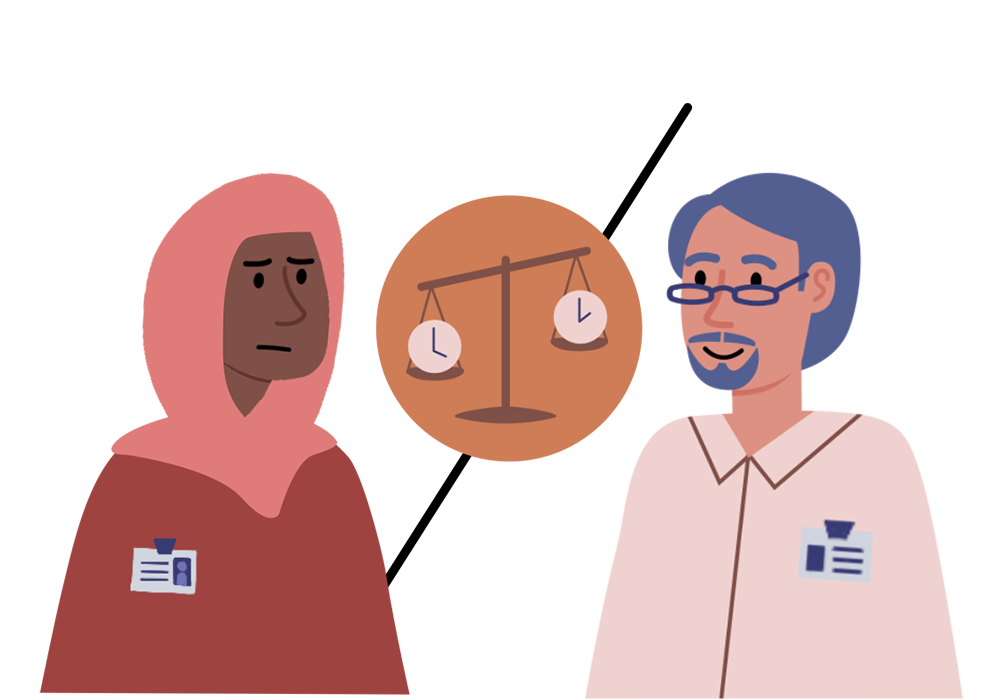

Illustration of two healthcare professionals wearing badges, a diagonal line separating them with a balance scale showing clocks, symbolising unbalanced time.

Recommendations

Reflect on the expectations held about GPs including the associations and assumptions when the word doctor, or GP is used.

Implement and evaluate initiatives that signal who staff are to challenge implicit biases.

Establish a shared understanding that women GPs often handle complex, emotionally demanding appointments and adapt systems in equitable ways that reflect and support this.

Support efforts to acknowledge and redistribute this workload fairly across the team where possible.

Protect time for high quality and enriching interactions with colleagues and patients by scheduling time for peer-to-peer connections and longer consultations.

Cultivate a working environment where it feels safe to report or speak up when witnessing gendered comments or unfair treatment. Reporting policies need to be visible and accessible to encourage others to use them safely, including patients.

Three circular icons showing a network of people, a rotating gear, and two stars on coloured backgrounds.

Concept 1:

Patient Facing Work

Illustration of a person smiling with a light bulb above their head symbolising an idea.

When women GPs encounter high quality, enriching interactions with patients and colleagues, then they are more likely to have job satisfaction and less likely to burnout, because this feeds their perceptions of meaningful work.

However, when women GPs experience gender-based mistreatment from colleagues and patients, then this may negatively impact their style of practice, professional identity and career development, because they feel physically and psychologically unsafe at work.

Illustration of two healthcare professionals wearing badges, a diagonal line separating them with a balance scale showing clocks, symbolising unbalanced time.

When all GPs are upheld to the same caring ideals, then a collaborative and empathetic patient centred culture is fostered, because professional identities become better balanced between genders.

However, when patients with complex health issues request to see women GPs and require a longer consultation, then women GPs career development and emotional wellbeing is negatively impacted, because they operate in a system that does not acknowledge their additional labour.

Three circular icons showing a network of people, a rotating gear, and two stars on coloured backgrounds.

Recommendations

Reflect on the expectations held about GPs including the associations and assumptions when the word doctor, or GP is used.

Implement and evaluate initiatives that signal who staff are to challenge implicit biases.

Establish a shared understanding that women GPs often handle complex, emotionally demanding appointments and adapt systems in equitable ways that reflect and support this.

Support efforts to acknowledge and redistribute this workload fairly across the team where possible.

Protect time for high quality and enriching interactions with colleagues and patients by scheduling time for peer-to-peer connections and longer consultations.

Cultivate a working environment where it feels safe to report or speak up when witnessing gendered comments or unfair treatment. Reporting policies need to be visible and accessible to encourage others to use them safely, including patients.

Explore more

Concept 2:

Navigating Competing Roles

Learn more

Concept 3:

Sustainable Careers, Leadership and Success

Learn more

Return to exhibition overview

Go back
Privacy Policy